
Nursing, education, social work and business courses set reflective essays every term, and almost none of them teach anyone how to write one. Students get a model, a word count and a deadline, then produce a story about a difficult day with a moral stapled to the end. The good essays do something different from the first paragraph, and the difference is learnable.
What is being marked
The grade attaches to the quality of your thinking about an experience, not to the experience itself. A dull Tuesday examined with honesty and theory will outscore a dramatic emergency retold as an anecdote. Tutors read for evidence that the experience changed how you understand your own practice, and that you can trace how.
The single most common failure is narration with a moral: eight paragraphs describe what happened, in order, with dialogue, and the final paragraph announces that communication is important. There is no analysis in it, so there is nothing to mark. A test before you submit: delete every sentence that describes what happened and see what remains. If the leftover is two sentences of feelings and a resolution, you have written a report, and it will be graded as one.
The models, honestly
Most briefs point you at one of four frameworks. None was built to be a section-by-section template, though that is how they get used.
| Model | Shape | Built for | Where it goes wrong |
|---|---|---|---|
| Gibbs’ reflective cycle (1988) | Six stages: description, feelings, evaluation, analysis, conclusion, action plan | A single incident examined in depth. The default in nursing and education. | Six equal paragraphs, one per stage, each opening with the stage name. |
| Kolb’s experiential learning cycle (1984) | Experience, reflective observation, abstract conceptualisation, active experimentation | Learning over a period: a placement, a project, a module. It asks how you learn, not how you felt. | Students force a one-off incident into it. Kolb has no feelings stage; bolting one on satisfies nobody. |
| Schön (1983): reflection-in-action and reflection-on-action | A distinction, not a sequence | Discussing professional judgement: what you noticed and adjusted in the moment versus what you understood afterwards. | It offers no structure at all, so essays that lean on it alone tend to wander. Use it as a lens inside another structure. |
| Rolfe et al. (2001): What? So what? Now what? | Three questions | Short reflections, journals, portfolio entries, tight word counts. The fastest route from event to implication. | The “so what” gets one paragraph when it deserves most of the essay. |
If the brief lets you choose: Gibbs for one incident, Kolb for a stretch of learning, Rolfe under about a thousand words, Schön as a lens inside any of them for judgement under pressure. Say in your introduction which model you are using and why it fits the material; that sentence signals more understanding than three pages of dutiful stages. A model is scaffolding, there to hold the building up while you work, and markers can see scaffolding left in place.
Choosing the incident
Students reach for the impressive story: the cardiac arrest, the classroom meltdown, the client in crisis. These are usually the wrong choice. In a dramatic event your role was small and your options were few; you followed protocol, or watched seniors act, and the honest analysis is “I did what the situation dictated.” There is little of you in it to examine.
The small uncomfortable moment is richer: the question you didn’t ask, the assumption about a family that turned out wrong, the instruction you followed while privately doubting it. Discomfort signals that something in your understanding was under strain, and that strain is the material a reflective essay needs. If a memory still makes you wince, write about that one. Two more filters: pick an incident with a real decision in it, because analysis needs a choice to examine, and pick one you can be honest about, since an incident you need to defend yourself over produces a defensive essay.
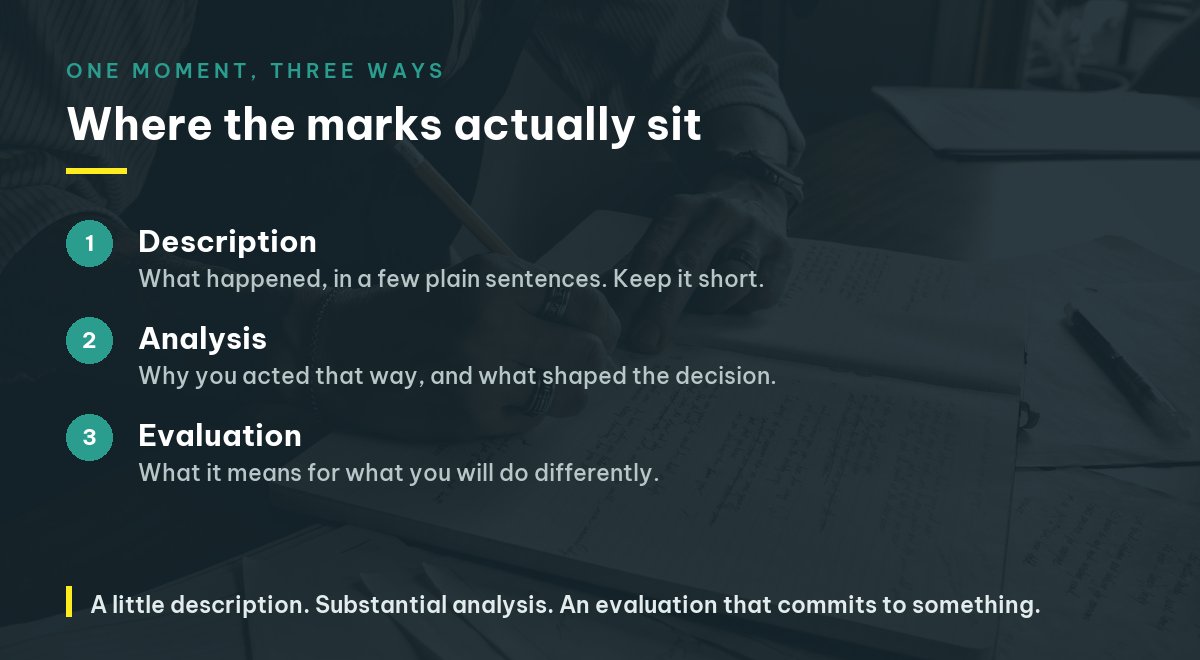
Description, analysis, evaluation: the same moment three ways
One incident: during handover on placement, I noticed a dose on a medication chart that didn’t match what was being said aloud, and I stayed silent.
Description
“During handover on my third week, I noticed the chart showed 5mg while the outgoing nurse said 10mg. I considered saying something but did not. The staff nurse caught the error ten minutes later.” This establishes facts. It earns no marks by itself, and it should be short.
Analysis
“I stayed silent for reasons I could name even at the time: I was the most junior person in the room, I doubted my own reading of the chart more than a qualified nurse’s speech, and being wrong in public seemed to cost more than staying quiet. That calculation matches what the literature on authority gradients describes in clinical teams.” Analysis takes the event apart and asks why each piece happened, connecting the personal to the general.
Evaluation
“My threshold for raising a concern was set by embarrassment rather than by risk to the patient, which inverts the priority my professional standards require. My problem was not knowledge; I had read the chart accurately. It is that my confidence in a challenge depends on my status in the room, so I need a technique that works from a junior position, such as framing the challenge as a question.” Evaluation weighs significance and points forward, with a judgement about yourself in it.
A strong essay contains all three in that order: a little description, substantial analysis, evaluation that follows from the analysis rather than floating free of it.
Writing about failure without theatre
Two failure modes sit on either side of the honest account. Self-flagellation: “I was completely unprofessional and betrayed my patient’s trust,” over a late piece of paperwork. Markers discount this, because exaggerated guilt avoids analysis; if the crime is enormous, no further thought is required. Self-justification is the mirror image: three paragraphs establishing that the ward was short-staffed, the mentor unclear, and anyone would have done the same. Same avoidance, opposite direction.
The honest middle names the mistake in one plain sentence, takes the share of responsibility that is yours, no more and no less, then spends the word count on mechanism: what chain of assumptions, pressures and habits produced the error, and which links you can reach.
Know where the boundary sits. A reflective essay is an academic exercise, not a confessional or an incident report. If the mistake involved actual harm, an unreported error, or anything with fitness-to-practise implications, it belongs in the proper reporting channel first, and probably not in coursework at all. Write about the near-miss, the misjudgement, the poor communication. If unsure whether an incident crosses the line, ask your tutor in the abstract before you draft.
Evidence: yes, you still cite
A reflective essay without sources is a diary. The academic content is the connection between your particular experience and the published general case: theory, professional standards, empirical studies. That connection is where most of the analysis marks live.
The bolted-on citation is easy to spot: a personal paragraph ends, a sentence beginning “According to Smith (2019)” appears, and the personal account resumes, unchanged by the visit. Weaving means the source does work on your experience:
- Use the source to explain your behaviour: “My silence fits the pattern the psychological safety literature describes, where team members weigh the interpersonal risk of speaking before the clinical risk of not speaking.”
- Use your experience to test the source: “Gibbs’ cycle assumes feelings can be separated from evaluation; in this incident the two arrived together, and separating them on the page felt artificial.”
- Use the source to open the next question: “If authority gradients suppress challenge, which forms of challenge survive the gradient? The human-factors literature suggests questions survive better than assertions.”
Confidentiality and ethics
Anonymise every patient, pupil, client, and colleague. That means more than swapping names for “Patient A”; it means removing the combination of details that identifies. A ward name plus a date plus a rare condition identifies a patient; a year group plus a specific behavioural incident identifies a child. Change or omit dates, locations, and any distinctive detail that is not doing analytical work, and state early that identifying details have been altered in line with your professional body’s guidance. Markers expect that sentence.
Voice and tense
First person is required, not merely permitted. “It was felt that the handover was unclear” hides from its own content; who felt it? Reflective writing is the one genre where “I” carries the argument, so write “I assumed,” “I decided,” “I missed.”
Feelings belong in named, specific form: embarrassed, defensive, relieved. Name the feeling once, then analyse what produced it and what it produced in turn. Three sentences of emotion is atmosphere; one named feeling plus its consequences is data.
Watch the double hedge. “I feel that the literature suggests” commits to nothing twice over. Either you feel something, so say what and own it, or the literature suggests something, so cite it and let it stand. Splitting the difference reads as an author unwilling to be caught holding a position.
Tense: past for the incident, present for what you now understand, future only in the action plan, and sparingly there.
Structure when the brief gives you none
A shape that works for a 1,500 to 3,000 word essay:
- Orientation, one short paragraph: setting, your role, the model and why.
- The incident, 10 to 20 per cent of the word count, told once, with the confidentiality statement.
- Analysis, the bulk: your reactions and decisions taken apart, theory woven in, alternative explanations weighed.
- Evaluation, what the analysis adds up to about your practice.
- Action, small and checkable: one or two specific changes, not “I will be more reflective.”
When the brief demands a specific model, use it, and say so, but let the stages be uneven. Gibbs’ description stage might be 150 words and his analysis stage 900; that imbalance is correct. Headings per stage are fine if the discipline tolerates them; if in doubt, use the stages as an ordering principle and write continuous prose. Never open a paragraph with “In this stage I will now.”
What markers notice in the first two pages
Recycled reflection. An incident so generic it fits any placement, or one the marker has seen from you in another module. Reflection has a texture of particularity: specific details, specific doubts. Generic incidents produce generic analysis, and the grade follows.
Invented incidents. The arc is too clean, the dialogue remembered verbatim, the mistake resolves into the exact lesson the module taught in week four. Real incidents are lopsided and leave loose ends; markers trust an essay more when part of the event still puzzles the writer.
The model applied mechanically. Equal-length stages, stage names as topic sentences, a feelings section that names four emotions and abandons them. This caps the grade because it shows the framework was followed rather than used.
An empty action plan. “I will continue to develop my communication skills” commits to nothing and closes the essay on its weakest sentence. One small concrete intention lands better: “At the next handover I will read the chart before the verbal report, so a discrepancy is mine to raise rather than mine to doubt.”
Frequently asked questions
Can I use “I” in a reflective essay?
Yes, and you must. The essay’s subject is your thinking, so third-person constructions like “it was observed that” hide the one thing being assessed. Use “I” for your actions, decisions and feelings, and keep the usual academic register for everything else: theory, evidence and other people’s work are cited and discussed in the normal way. The mix of personal voice and academic sourcing is the genre.
Do I still need references?
Yes. Reflection without literature is a diary entry, and most marking criteria award a large share of the grade to connecting experience with theory. Aim for four to eight sources used to explain, test or extend your account, rather than a long bibliography of name-checks. Cite the reflective model itself correctly: Gibbs (1988), Kolb (1984), Schön (1983), or Rolfe et al. (2001).
What if nothing significant happened on my placement?
Something did; it was small, which is better. A question you didn’t ask, an assumption that proved wrong, a routine task you performed without understanding why. Reflective essays reward depth of analysis, not scale of event, and a marker would rather read a sharp examination of a two-minute exchange than a flat retelling of an emergency in which your only role was to watch.
How much of the essay should be description?
Ten to twenty per cent. The incident needs to be told once, plainly, early, with enough detail for the analysis to grip. Everything past that point should be doing analytical or evaluative work. A quick check: if you deleted every purely descriptive sentence, would most of the essay survive? If not, the balance is wrong, and the fix is to cut narration rather than to add length.
Can I write about a mistake without getting into trouble?
For ordinary misjudgements, near-misses and poor communication, yes; tutors read hundreds of these and expect honesty. The boundary is at incidents with formal consequences: actual harm, unreported errors, or anything touching fitness to practise or safeguarding. Those belong in proper reporting channels, not coursework. If you are unsure whether an incident crosses that line, describe it to your tutor in general terms before drafting.
Which model should I use if the brief doesn’t specify?
Match the model to the material. Gibbs (1988) suits a single incident examined in depth. Kolb (1984) suits learning across a longer period, such as a whole placement. Rolfe et al.’s What? So what? Now what? works for short pieces and journals. Schön’s reflection-in-action is a lens for discussing judgement under pressure inside any structure. Name your choice in the introduction and give one sentence of justification.
Is it acceptable to say I disagreed with my mentor?
Yes, if the essay analyses the disagreement rather than prosecuting it. Keep the mentor anonymous and unidentifiable, present their reasoning as fairly as you can, and focus on your side: why you disagreed, why you did or didn’t voice it, and what that reveals about how you handle authority. An essay proving the mentor wrong earns nothing; an essay examining your own response to the conflict earns a lot.
