
Sooner or later someone hands you a reading list full of primary literature and assumes you know what to do with it. Most students read each paper like a novel, front to back, and retain almost nothing. There is a better way; nobody teaches it because the people who set reading lists learned it by trial and error and forgot it was ever hard.
Why reading front-to-back fails
A paper is not meant to be read in the order it is printed. The introduction is a sales pitch for the question, the discussion a sales pitch for the answer. The evidence sits in the middle, in the figures, tables and methods, the only part you can evaluate for yourself.
Read straight through and two things go wrong. You hit the methods cold, drown in jargon, and give up around the reagent list. Worse, by the time you reach the results you have absorbed the authors’ framing. The discussion exists to persuade you, and its writers have the strongest motive to believe the result. They are not dishonest; they are advocates, and advocacy belongs at the end of your reading.
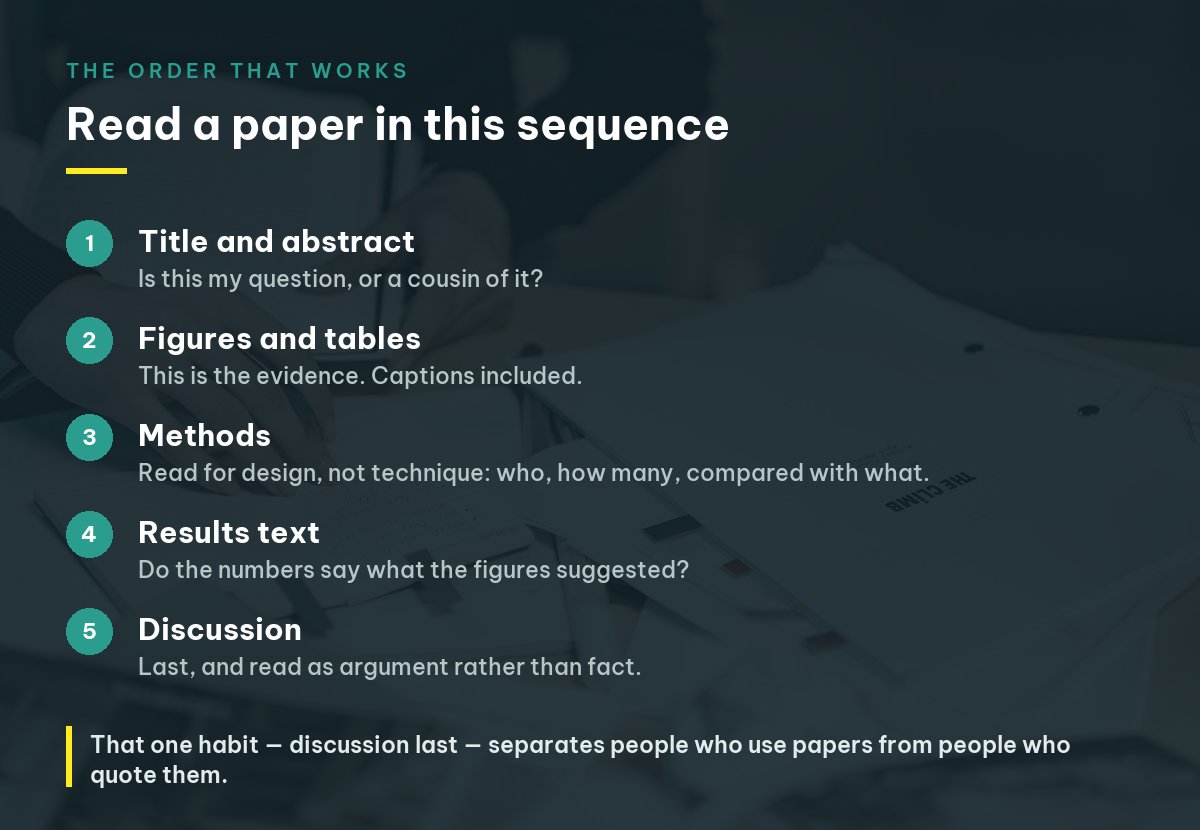
The order that works:
- Title and abstract, to decide whether the paper deserves your time.
- Figures and tables, captions included, because this is the evidence.
- Methods, skimmed for design: who or what was studied, how many, compared with what.
- Results text, to check the numbers say what the figures suggested.
- Introduction, if you need background.
- Discussion last, once you have formed your own view.
That one habit, discussion last, separates people who use papers from people who quote them.
The 60-second triage
You cannot give an hour to each of forty search results. My own sequence:
- Title: is this my question, or a cousin of it? A related question is a citation for your introduction, not a paper to dissect.
- Abstract, last two sentences: the finding usually lives there. Irrelevant to your argument means stop.
- Journal and year: an old paper can still be the definitive one, but check whether later work supersedes it.
- One glance at the figures: do they look like data (axes, error bars, ns) or like diagrams of what the authors believe? Figures that are all schematics mean an opinion wearing a lab coat.
- Sample size: 12 undergraduates answer a different kind of question than 12,000 patients.
Sixty seconds sorts papers into three piles: read properly, skim for one fact, discard. Most belong in the third pile, and discarding them is the job, not laziness.
How to read a figure
Figures are where the study holds up or falls apart. Slow down here.
Axes first
Check both axes before the shape of the data. A y-axis starting at 47 instead of 0 turns a 3% difference into a cliff. A log scale compresses tenfold differences into tidy steps. Neither is fraud; both mislead if you skip the numbers on the frame.
Error bars, and what they are
Find the caption sentence saying what the bars represent. Standard deviation describes the spread of individual measurements. Standard error and confidence intervals describe confidence in the mean, and shrink as the sample grows, so they look tidier for the same messy data. Bars that overlap heavily are weak evidence of a difference, whatever the asterisk claims. A caption that never defines the bars marks the figure as decoration.
The n hides in the caption
Sample size hides in the caption’s small print, in phrases like “n = 3 independent experiments”. Three is common in laboratory biology, and it means the bar chart summarises three numbers. Fine for a mechanism; nowhere near fine for a clinical claim.
“Representative image” means chosen
A representative micrograph, blot or photo is the one the authors picked to show you. In honest hands it is typical of the set; in careless hands it is the best one. Either way, one image proves a thing can happen, not how often. The quantification across replicates is the evidence; the image is the illustration.
Methods red flags you can spot without statistics
You do not need to be a statistician to catch most of what goes wrong. You need a short checklist and the nerve to apply it to published work.
- Tiny n for the claim being made. No universal minimum exists, but the sample must match the ambition. Eight mice can support “this pathway can be activated”. Eight patients cannot support “this treatment works”.
- No control group, or the wrong one. “Patients improved after treatment” means nothing without knowing what untreated patients did, because many conditions improve on their own. Find the comparison group and check it differs only in the thing being tested.
- Post-hoc subgroups. If the overall result was null but the effect “was significant in women over 50”, ask whether the authors planned that subgroup before seeing the data. Slice a dataset enough ways and something comes up significant by chance.
- The outcome moved. Registered trials state their primary outcome in advance. A headline outcome that differs from the registered one suggests the planned measure disappointed. The registration number is usually in the abstract; you can check the registry yourself.
- P-values without effect sizes. p < 0.05 says a difference is unlikely to be pure chance; it says nothing about size. With enough participants, a drug that lowers blood pressure by a meaningless amount still produces a beautiful p-value. Ask “how big?” before “how sure?”.
- “Trend towards significance.” This phrase and its relatives mean the result missed the authors’ own threshold and they want you to count it anyway. By the same logic p = 0.04 is trending towards non-significance, a sentence no paper has printed.
One or two of these is normal science, worth a sentence of criticism in your essay. All at once is a paper to cite as a cautionary example or not at all.
Results versus discussion: mind the gap
The results section reports what was measured. The discussion argues for what it means. That distance is where students get burned: essays that repeat a discussion’s claims inherit its optimism.
A common example. Results: “Participants who consumed the supplement scored higher on a word-recall test 30 minutes later.” Discussion: “These findings suggest the supplement may enhance memory and could have implications for cognitive decline in ageing populations.” Watch the gap. One test became “memory”. Thirty minutes became relevance to ageing, a process measured in decades. Healthy volunteers became a proxy for people with cognitive decline. Each step carries a hedge (“suggest”, “may”, “could”), the honest convention for speculation, but quote the sentence without the hedges and a word-game result becomes a dementia claim. Press offices do this for a living. Your essay should not.
What each study type can and cannot prove
Half of critical reading is knowing the ceiling of the design. A flawless case report cannot do what a mediocre cohort study can.
| Design | What it is | Good for | Cannot do |
|---|---|---|---|
| Case report / series | Description of one patient or a handful | Flagging new diseases, rare reactions, surprises worth studying | Establish frequency or cause; no comparison group |
| Cross-sectional | Snapshot of a population at one moment | Prevalence, associations, generating hypotheses | Establish which came first; exposure and outcome measured together |
| Cohort | Groups followed forward through time | Linking exposures to later outcomes; exposures you could never assign, like smoking | Rule out confounding; exposed and unexposed differ in more than the exposure |
| Randomised controlled trial | Participants assigned to treatment or control by chance | Causal claims about the intervention, in the population enrolled | Guarantee results generalise beyond its (often narrow, monitored) participants |
| Systematic review / meta-analysis | Structured synthesis of all studies on a question, ideally following PRISMA guidelines | The overall state of evidence; exposing inconsistency between studies | Fix its ingredients; a synthesis of biased studies is a confident summary of bias |
The payoff: when a cross-sectional study is quoted as proof that X causes Y, you can object on design grounds alone, without touching the statistics. The hierarchy is a guide, not a law; a large, careful cohort can outrank a small, sloppy trial.
Predatory journals: checking a venue without a subscription
Some journals will publish anything for a fee, with peer review that is fake or a formality. Citing one in a dissertation is embarrassing at best. You can screen a venue in minutes with free tools:
- Look the journal up in the Directory of Open Access Journals (DOAJ) if it is open access. Listing is a screening signal; absence is a question to investigate, not a verdict.
- Check whether your library subscribes or indexes it. Librarians filter this professionally and are pleased to be asked.
- Read the journal’s website like a sceptic. Red flags: review turnaround promised in days, a scope covering wildly unrelated fields, prominent fees with a vague review process, an editorial board with no institutional pages, an “impact factor” from a metrics company you have never heard of.
- The spam test. Journals recruiting authors by mass email flattering their previous work are advertising their standards.
No single check is decisive, but together they take ten minutes and keep the worst venues out of your reference list.
Preprints: fine to cite, with conditions
A preprint is a manuscript posted publicly, on a server such as arXiv, bioRxiv or medRxiv, before peer review. Much of physics has run on preprints for decades, and in fast-moving fields they carry the newest results months before journals do.
Citing one is fine when it is the newest work on your question, you label it as a preprint in the reference, and your claim does not stand or fall on it alone. It is not fine when a peer-reviewed version exists (cite that instead; check, because many preprints are published later under different titles), when the preprint is the sole support for a strong claim, or in clinical contexts. Peer review misses plenty, but it is one filter, and a preprint has passed zero. Read its methods with extra care, since nobody else has been obliged to.
A workflow that survives until essay-writing time
The gap between “I read that somewhere” and a defensible citation is your note-taking. Reading without notes is entertainment.
For each paper you keep, record five things while it is open: the full citation with DOI; the design and sample in one line (“RCT, 240 adults with insomnia, 8 weeks”); the key result with its actual numbers; one line of your own criticism, using the red-flag list above; and one line on where it fits your argument. Your future self will thank you for that last line. Two months on, a stack of unannotated PDFs is a decoration, not a literature review.
On reference managers, one honest paragraph: use Zotero or an equivalent, start in week one, and expect it to save you hours of formatting misery. Do not expect it to think. The browser plugin imports records with wrong capitalisation, missing page numbers and dead links, and that garbage resurfaces in your bibliography. Check each record on import, thirty seconds, instead of auditing two hundred at 3 a.m. before the deadline.
AI summaries: useful servant, terrible oracle
AI tools are good at three reading tasks: a rough orientation to a difficult paper before you tackle it yourself, explaining a method or statistical term you have not met, and triaging a long list of titles and abstracts.
Two failure modes matter. First, invented citations: ask a chatbot for papers and it may produce plausible references, real authors, real-sounding journals, that do not exist. Verify each one in a real database before it goes near your bibliography; examiners check DOIs, and a fabricated reference reads as misconduct even when a tool made the error, because you signed the work. Second, even summarising a real paper you uploaded, the tool summarises claims, not evidence. It relays the discussion’s framing with confidence and misses the n of 9, the missing control or the moved outcome unless you ask pointed questions. The summary tells you what the authors say; the methods tell you whether to believe them, and no current tool relieves you of reading them. Treat AI output as a colleague’s quick verbal take, not a source.
Frequently asked questions
How long should one paper take me to read?
Triage takes a minute. A skim for one fact takes ten. A proper read of a paper central to your dissertation takes an hour or more, and gets faster with practice. For a typical essay, expect a handful of papers read properly and a larger ring skimmed for specific points.
Do I have to understand every method in the methods section?
No. Read for design, not technique: who or what was studied, how many, what was compared and measured. You can evaluate those without knowing how the assay works. Look up a technique only when the central claim depends on it. First-year undergraduates are not expected to audit a mass spectrometry protocol.
Is it acceptable to cite a paper I found through a review?
Cite what you read. If you read only the review, cite the review; the format for “as cited in” varies, so ask your department. If the original claim matters to your argument, get the original and read at least its results. Chains of second-hand citation are how errors fossilise.
What if two good papers directly contradict each other?
That is normal, and writing about it well earns marks. Compare designs first (a trial outranks a cross-sectional study), then samples (different populations give different answers), then measures (two “memory” studies may have measured different things). Do not cite the one that suits you and hide the other; your marker has usually read both.
Can I cite a preprint in my dissertation?
Usually yes, if your department allows it: label it as a preprint, include the server and DOI, and check whether a peer-reviewed version now exists, because that supersedes it. Do not rest a central claim on a preprint alone, and be extra cautious with clinical topics; your supervisor knows the local rules.
The paper is behind a paywall. What are my legitimate options?
Your library first: subscriptions, then interlibrary loan for anything they lack, free at most universities. Next, look for a legal open copy: many authors deposit accepted manuscripts in institutional repositories, and a browser extension like Unpaywall finds these. Emailing the corresponding author for a copy is normal practice and usually works; authors like being read.
